
Clinch County Court Records After Arrest
A Clinch County jail arrest can create more than one kind of record. The sheriff or arresting agency handles the arrest and booking side. The courts handle warrants, first appearance, preliminary hearings, bail, and the criminal case file. The local path is compact because the sheriff, clerk, and magistrate offices are all tied to the Homerville Court Square area, but the custody side may not stay local. Current research shows no official Clinch online jail roster and no active local jail population in recent population sources, so a person arrested in Clinch may be routed through the sheriff first and then housed by Coffee County.
The court record begins to matter when the charge leaves the booking stage. The Clinch County Clerk of Superior Court files criminal cases and maintains criminal warrants. The Probate and Magistrate Court handles arrest warrants, search warrants, preliminary hearings, minor and felony criminal matters, and bail where bail is not reserved to another judge. The District Attorney for the Alapaha Judicial Circuit prosecutes indictable Superior Court offenses. For custody and booking details, use Clinch County jail inmate records; for booking photos, use Clinch County jail mugshots.
Clinch County Criminal Case Offices
The main court-record offices split the work by stage. The Clerk of Superior Court is the best starting point for filed Superior Court criminal cases, case documents, and criminal warrants. The Probate and Magistrate Court is the local source for many warrant, bail, and preliminary-hearing questions. The Alapaha Judicial Circuit District Attorney decides how indictable offenses are prosecuted and supervises victim assistance. Court staff and judges cannot provide legal advice, so requests should ask for records, dates, filings, or status, not for a legal strategy.
Clerk of Superior Court
25 Court Square, Suite C
Homerville, GA 31634
912-487-5854
Criminal cases, warrants, court records
Probate and Magistrate Court
110 Court Square
Homerville, GA 31634
Magistrate 912-487-2514
Warrants, preliminary hearings, bail
Alapaha Circuit District Attorney
115 South Davis Street
Nashville, GA 31639
229-686-7015
Superior Court prosecution and victim assistance
Clinch Court Records Online Access
Georgia Courts e-access lists Clinch Superior Court and sends users to a provider website for records access. The Clinch Superior route goes through PeachCourt. The public PeachCourt access screen shows login, registration, civil and criminal e-filing, and court-document access, but the research did not inspect private account search fields. That means a Clinch County court records after arrest search should treat PeachCourt as an account-based route, not as a no-login public roster with known fields.
The Georgia Courts e-access page is the official statewide starting point for provider routing. The PeachCourt access page is the account path for court documents. If the case is too new, sealed, juvenile, restricted, or not yet filed, the online route may not answer the question. In that situation, call the clerk or magistrate office and ask which court has the file.
| Access Point | What It Shows | Limit |
|---|---|---|
| Georgia Courts e-access | Clinch Superior provider routing | Provider account required for search |
| PeachCourt | Civil and criminal e-filing and documents | Search fields after login were not inspected |
| Clerk phone or counter | Filed criminal case and warrant record questions | Copy fees or certified-copy rules may apply |
The official Georgia Courts page below shows the statewide provider route used for Clinch Superior Court.
Georgia Courts e-access identifies the provider path for court records, including Clinch Superior Court.
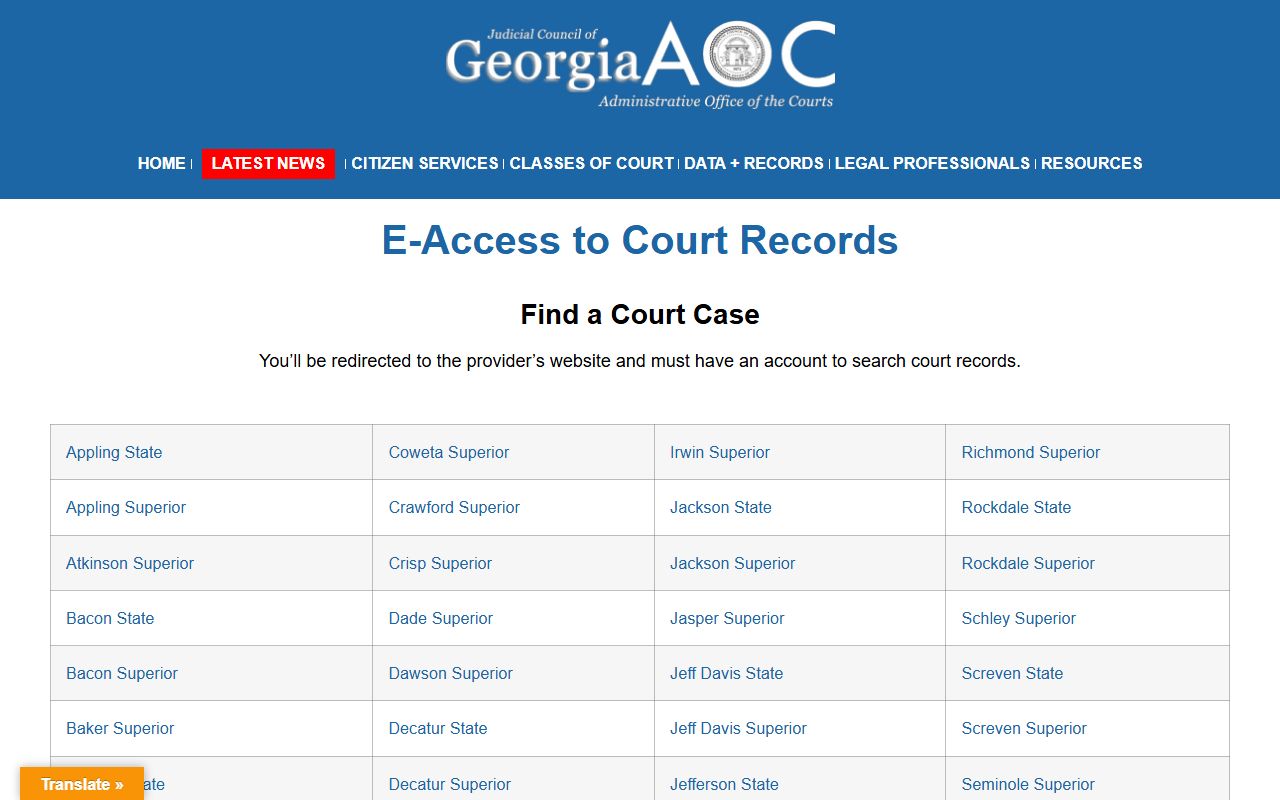
Use that statewide page to confirm the provider before trying to search for filed charges in a Clinch County court case.
Find Charges After Clinch Arrest
A charge may appear in one place before another. The arrest charge can be listed by law enforcement at booking, while the formal court charge may wait for a prosecutor filing, warrant return, accusation, indictment, or later amendment. A clean search checks custody first, then court filing, then prosecution status if needed.
- Call the Clinch County Sheriff's Office at 912-487-5316 to confirm whether Clinch booked the person and where the person is housed.
- Ask whether the listed offense is only a booking charge or whether a criminal case has been filed.
- Call Magistrate Court at 912-487-2514 for warrant, preliminary-hearing, and bail questions.
- Use the Georgia Courts e-access route to PeachCourt or contact the Clerk of Superior Court at 912-487-5854 for Superior Court felony filings.
- Contact the District Attorney at 229-686-7015 for prosecution status when the filed charge is unclear or a record-restriction route is needed.
Certified copies, older records, and records not visible online may require a clerk request. No Clinch-specific criminal-copy fee schedule was located in the research, so a request should ask the clerk for the current fee before ordering copies.
Charging Documents After Arrest
The charging document is the bridge between the arrest and the court record. A complaint, accusation, information, indictment, or presentment tells the court what offense is being pursued. In the Alapaha Judicial Circuit, the DA represents the state in Superior Court criminal cases, advises grand juries, and prepares indictments or presentments when requested by the grand jury.
| Document | Usual Source | What It Means |
|---|---|---|
| Complaint or accusation | Officer, prosecutor, or court process | A formal allegation used to start or continue a criminal case. |
| Information | Prosecutor | A prosecutor-filed charge used where Georgia procedure allows it. |
| Indictment or presentment | Grand jury with DA support | A grand-jury charging document for serious Superior Court offenses. |
Do not assume the first booking label is the final court charge. A prosecutor may add, reduce, amend, dismiss, or decline a charge after reviewing reports and evidence.
Clinch Charge Status Records
Charge status shows where the case stands. A pending charge is not a conviction. An amended charge may replace the arrest charge. A dismissed or nolle prossed charge may still leave a historical court record unless it is later restricted under Georgia law. These terms matter when reading Clinch County court records after a jail arrest because public case screens can mix old and current labels.
| Status | Meaning in Plain Terms |
|---|---|
| Pending | The charge or case has not reached final disposition. |
| Amended or reduced | The filed charge changed from the original arrest or charging label. |
| Dismissed | The court ended the charge without a conviction on that count. |
| Nolle prosequi | The prosecutor chose not to pursue the charge. |
| Conviction | A guilty plea, verdict, or other final finding of guilt. |
Warrants Bail and Court Arrest Records
No official Clinch online active-warrant search was located. Warrant questions route through the sheriff, clerk, and magistrate. The Clerk of Superior Court maintains criminal warrants, while Magistrate Court handles arrest warrants, search warrants, good behavior warrants, bad check warrants, and preliminary hearings. A bench warrant may also appear when a judge issues it after a missed court date or similar court event.
Bond and bail records follow the same local path. The magistrate page states that Magistrate grants bail in cases that are not reserved exclusively to another court. To confirm release terms, call the sheriff first, then the housing facility if the person was moved to Coffee County. Ask whether the court set cash bond, surety bond, property bond, personal-recognizance release, or a no-bond hold.
| Release Term | How It Works |
|---|---|
| Cash bond | Money is paid directly under court or jail rules, with refund depending on case outcome and compliance. |
| Surety bond | A licensed bonding company posts bond for a fee and takes responsibility for appearance. |
| Property bond | Property is pledged if allowed by court rules. |
| PR bond | The person is released on a promise to appear without secured cash or surety. |
| No-bond hold | Release is blocked until a judge changes the order or another hold is cleared. |
Charges Convictions and Restricted Records
Georgia court records after an arrest must be read with care. An arrest means a person was taken into custody. A charge means an accusation is being made. A conviction means guilt was found by plea or verdict. A dismissed charge or restricted record should not be treated as the same kind of event as a conviction.
| Record Type | Charge | Conviction |
|---|---|---|
| Stage | Accusation after arrest or filing | Final plea, verdict, or finding |
| Proof level | Probable cause or formal allegation | Beyond reasonable doubt or admitted guilt |
| Use | Case tracking and court process | Sentencing, criminal history, and later custody records |
Georgia uses the term record restriction more often than expungement. The Alapaha Judicial Circuit record-restriction page includes Clinch County and says arrests after July 1, 2013 generally route restriction requests to the DA's Office, while older arrests begin with the arresting agency. The GBI record restriction guidance gives the statewide criminal-history route.
| Term | Georgia Practical Meaning | Where to Start |
|---|---|---|
| Restricted | Public access to an eligible criminal-history record is limited. | DA for post-July 1, 2013 arrests, arresting agency for older arrests. |
| Sealed | A court record may be hidden from ordinary public view by law or order. | Clerk or court order process. |
| Expunged | Often used by the public, but Georgia guidance uses record restriction language. | GBI, DA, court, or arresting agency depending on record type. |
Georgia Law for Arrest Court Records
Georgia's Open Records Act favors public access, but it has limits. O.C.G.A. 50-18-70 defines public records broadly, and O.C.G.A. 50-18-71 sets the response and fee framework. Agencies generally must respond within three business days, or explain timing, cost, or exemptions. Pending law-enforcement and prosecution records can be exempt, but the Georgia Attorney General guide notes that initial arrest and incident reports have special public-access treatment.
Jail records have their own rule. O.C.G.A. 42-4-7 requires sheriffs to keep records of people committed to county jail, including identifying details, process, court, charge, commitment date, and discharge data. Court records, jail records, criminal-history records, juvenile records, medical data, and booking photographs are not all released under the same rule, so ask the office for the specific record type needed.
Important: Privately published lookup information is not a consumer report and cannot be used for employment, tenant, insurance, credit, or similar FCRA decisions.
Alapaha DA After Clinch Arrest
The District Attorney for the Alapaha Judicial Circuit is the prosecution source for indictable Superior Court cases from Clinch County and the other circuit counties. The official DA page identifies Chase Studstill as district attorney, lists the Nashville office, and says the office represents the state in criminal cases, advises grand juries, prepares indictments and presentments when requested, argues criminal appeals, and supervises victim assistance.
The DA does not replace the jail or clerk. It becomes most useful when the issue is prosecution status, indictment, victim assistance, or record restriction after a Clinch arrest. The DA office can also clarify whether a charge is still being pursued when a booking charge and court record do not match.
The PeachCourt account screen below is the official provider doorway reached from the statewide e-access route.
PeachCourt access is used for Georgia court documents and civil or criminal e-filing after account access.

When PeachCourt does not show a new or restricted case, the clerk, magistrate, or DA can point to the correct next office.